

There are wildlife events. And then there is the Great Wildebeest Migration. There is truly nothing else on earth quite like it, nothing that combines scale, drama, raw natural power, and sheer, overwhelming beauty in quite the same way. It is the kind of event that makes you feel genuinely small in the most magnificent sense of the word, a reminder that the natural world operates on a scale and a timeline that dwarfs everything human beings have ever built or imagined.
Here at Serenity Mara Legends Camp, we have the extraordinary privilege of sitting right at the heart of this spectacle every year. And we want to make sure that when you come to witness it, you are ready for everything it has to offer.
What Exactly Is the Great Wildebeest Migration?
Let us start at the beginning, because the Great Wildebeest Migration is one of those events that is easy to reference and surprisingly difficult to fully appreciate without context.
Every year, in an ancient, instinct-driven cycle that has been repeating itself for hundreds of thousands of years, approximately 1.5 million wildebeest, accompanied by around 500,000 zebras and 200,000 gazelles, make a continuous, circular journey across the ecosystem that spans the Serengeti National Park in Tanzania and the Maasai Mara National Reserve in Kenya. This is not a migration in the traditional sense of a one-way seasonal movement. It is a perpetual loop, a year-round, clockwise journey across roughly 3,000 kilometres of savannah, driven entirely by the search for fresh grass and water.
The herds follow the rains. Where the rains fall, the grass grows. Where the grass grows, the wildebeest go. It is a relationship between animal and ecosystem so perfectly calibrated, so ancient and so precise, that it feels less like behaviour and more like choreography. It’s like a dance between a million and a half animals and the land they move across, performed without direction and without deviation, year after year after year.
The result is one of the most spectacular natural events on the planet. And the Mara River crossings that happen on the Kenyan side of the ecosystem are where that spectacle reaches its most dramatic, most heart-stopping, most utterly unforgettable peak.
The Annual Cycle: Where Are the Wildebeest and When?
Understanding the Migration’s annual rhythm is essential for planning your visit, and it is something our team at Serenity Mara Legends Camp is always happy to discuss in detail. Here is a season-by-season guide to where the herds are and what is happening throughout the year.
January to March: Calving Season in the Southern Serengeti
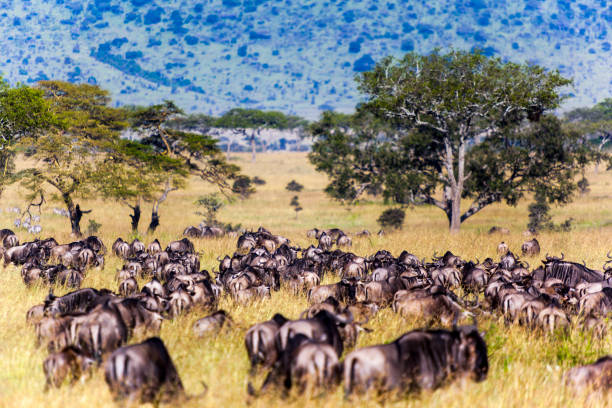
The year begins in the short grass plains of the southern Serengeti and Ngorongoro in Tanzania, where the wildebeest gather in their hundreds of thousands to give birth. This is the calving season, and it is extraordinary in its own right. Approximately 500,000 wildebeest calves are born within a concentrated period of just a few weeks, an evolutionary strategy that overwhelms predators through sheer numbers and gives the maximum number of calves a fighting chance of survival.
The southern Serengeti during calving season is a landscape of breathtaking tenderness and raw predator activity simultaneously. Newborn calves take their first wobbling steps while lions, cheetahs, and hyenas circle at the edges of the herd. It is nature at its most honest and its most moving.
April to June: The Long Rains and the Journey North
As the long rains arrive and the southern plains begin to dry out, the herds start their long journey northward through the central and western Serengeti. This is a period of movement and energy. Vast columns of wildebeest stretching across the landscape as far as the eye can see, raising great clouds of dust as they push through the Serengeti’s woodlands and open plains.
The western corridor of the Serengeti sees the first major river crossings of the year during this period, as the herds encounter the Grumeti River. This is a crossing that offers its own dramatic spectacle, including some of the largest Nile crocodiles in Africa lurking in wait.
July to October: The Mara River Crossings
And then comes the moment the entire world’s wildlife community waits for. Between July and October, the wildebeest herds push north across the Tanzania-Kenya border and into the Maasai Mara. With them comes the most famous and most dramatic chapter of the entire Migration story.
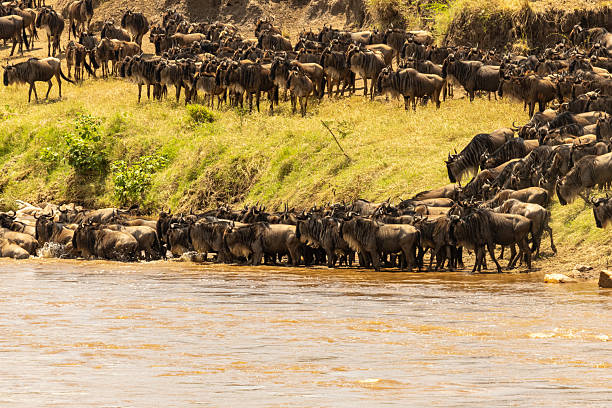
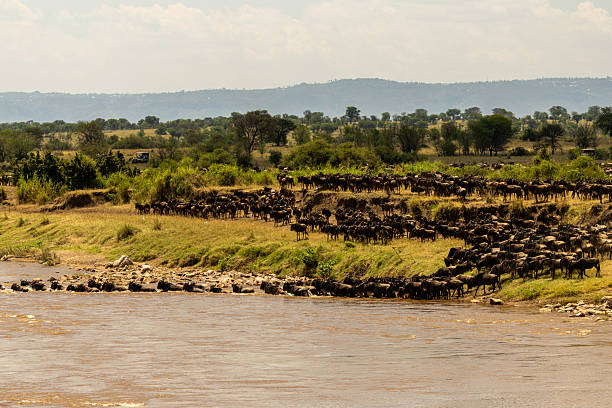
The Mara River crossings are the beating heart of the Migration experience, and they are the reason that the Maasai Mara is, during these months, the most sought-after safari destination on the planet. The herds gather on the riverbank in their thousands, nervous, hesitant, surging forward and pulling back in a collective indecision that can last hours before the moment of commitment arrives.
And then, suddenly, it happens. One wildebeest leaps. Then another. And then the herd follows in a thundering, chaotic, magnificent torrent. Thousands of animals plunge into the river simultaneously, scrambling up the far bank, and scattering across the Mara plains in a cloud of dust and noise and raw, elemental energy. Meanwhile, in the river below, massive Nile crocodiles (some of the largest in Africa) move with sudden, explosive speed through the churning water.
It is terrifying, beautiful, heartbreaking, exhilarating and overwhelming, all at once. And it happens, in various locations along the Mara River, repeatedly throughout the July to October season. This means that guests who spend enough time in the right place have genuine, repeated opportunities to witness multiple crossings during a single visit.
Tip
At Serenity Mara Legends Camp, our location and our experienced guides put you in the very best position to witness this spectacle. Our team monitors the herds closely throughout the season, tracking their movements and positioning our game drives to maximise crossing opportunities for our guests. It is, without question, one of the greatest wildlife experiences on earth, and we are deeply proud to offer our guests a front-row seat.
November to December: The Return South
As the short rains arrive in November and the Mara’s grass is grazed down, the herds begin their return journey southward. They head back across the Mara River,n through the Serengeti, and back toward the southern plains where the cycle will begin again with the new calving season in January.
The November crossings are less widely known than the peak July to October season but offer their own wonderful opportunities, often with significantly fewer visitors and a more intimate, personal experience of the Migration.
What Makes a Mara River Crossing So Special?
We have described the crossings in broad terms, but it is worth pausing to really convey what it feels like to witness one up close. This is because no amount of documentary footage quite prepares you for the reality.
The first thing that strikes you is the sound. The rumble of thousands of hooves on dry earth, building from a distant tremor to something that you feel as much as you hear. Then the smell from the dust, the river water, the raw, animal intensity of thousands of bodies moving as one. Then the sight of the river itself. You see the surface churning white with the force of the crossing, animals swimming powerfully for the far bank, crocodiles moving with sudden, terrifying speed beneath the surface.
And then there is the emotion that comes with the whole show. It’s something that surprises almost every first-time witness. People cry at the crossings. Not because it is sad, though the vulnerability of the calves and the brutal efficiency of the crocodiles does carry its own sobering weight, but because it is overwhelming. Because witnessing nature operating at this scale, this power, and this ancient, unstoppable purpose does something to a person that is very difficult to articulate and impossible to forget.
Our guides are wonderfully attuned to this experience. They give guests the space to feel it, the knowledge to understand it, and the time to absorb it fully before the vehicle moves on. A crossing witnessed at Serenity Mara Legends Camp is never rushed.
Practical Tips on Planning Your Migration Safari
When to Come
For the Mara River crossings, plan your visit between late July and October. August and September are statistically the peak months for crossing activity, but the season can begin as early as late June and extend into November, depending on the rains. Our team monitors the herds in real time throughout the season and can advise on current conditions as your travel dates approach.
How Long to Stay
River crossings are unpredictable by nature — the wildebeest operate on their own schedule, and patience is an essential part of the experience. We recommend a minimum of three nights at Serenity Mara Legends Camp during Migration season to give yourself a genuine chance of witnessing a crossing. Four to five nights are even better, and guests who stay longer are almost always rewarded with multiple crossing experiences of varying scale and drama.
Where to Stay
Location matters enormously during the migration season. Serenity Mara Legends Camp’s position in the Mara ecosystem places our guests within striking distance of the key crossing points along the Mara River, and our guides’ intimate knowledge of the herds’ movements means we are always well positioned to respond quickly when crossing activity begins. Our accommodation options range from our comfortable Standard Tents to our indulgent Luxury Suites, all offering the same exceptional guiding, warm hospitality, and immersive Mara experience that makes a Migration safari with us so memorable.
Book Early: This Cannot Be Overstated
Migration season is the most in-demand period across the entire Maasai Mara, and availability at quality camps fills up many months in advance. If you are planning a Migration safari, please do not leave your booking to the last minute. Contact our team as early as possible, ideally six to twelve months ahead of your intended travel dates, to secure your place and avoid disappointment.
Beyond the Crossings, The Migration Season Is Rich With Wildlife
It is worth emphasising that even without a river crossing, the Maasai Mara during Migration season is extraordinarily rich with wildlife activity. The presence of the vast wildebeest herds attracts predators in significant numbers. Lions are exceptionally active, cheetahs are frequently spotted hunting on the open plains, and leopard sightings are consistently excellent throughout the season.
The entire ecosystem is elevated during these months. More animals, more predator activity, more drama, more opportunity. Every game drive carries the electric possibility of something extraordinary, and our guides at Serenity Mara Legends Camp thrive in these conditions, bringing the full, magnificent story of the Migration to life for every guest who joins us. Explore all our activities and discover how we make the most of every single day during this extraordinary season.
The Migration and the Bigger Picture
The Migration is not just a wildlife event. It is a reminder. A reminder of the extraordinary complexity and resilience of natural ecosystems. A reminder of how much the natural world is capable of when it is given the space and the protection to operate as it was designed to. And a reminder of our responsibility to protect these ecosystems, support the communities and conservation organisations working to preserve them, and approach the natural world with the humility and gratitude it deserves.
At Serenity Mara Legends Camp, conservation is not a buzzword. It is a commitment that shapes everything we do. From our relationships with local Maasai communities to the way we conduct our game drives and manage our footprint in this precious landscape. When you choose to visit us during Migration season, you are not just witnessing one of the world’s greatest natural events. You are contributing to its protection. And that, we believe, is something genuinely worth celebrating.
Come and Witness the Greatest Show on Earth
The Great Wildebeest Migration has been happening in the Maasai Mara for longer than human memory reaches. It will, if we protect it wisely, continue for generations yet to come. But it is happening right now, this year, this season, just as it has every year before. And the question, as always, is simply whether you are going to be there to see it.
We hope you will be standing on the bank of the Mara River, breath held, as the first wildebeest leaps and the thunder begins. We hope you will feel what every guest who has witnessed a crossing feels. That overwhelming, humbling, deeply human sensation of being in the presence of something so much larger than yourself that it rearranges something fundamental inside you.
That is what the Migration does. And it is what we at Serenity Mara Legends Camp are privileged to share with our guests, season after season, year after year.
Ready to witness the Greatest Show on Earth? Contact our team today and let us help you plan your Great Migration safari at Serenity Mara Legends Camp. Book early, come ready, and prepare to be changed forever by one of the most extraordinary experiences the natural world has to offer. The wildebeest are already on their way.